Quick answer
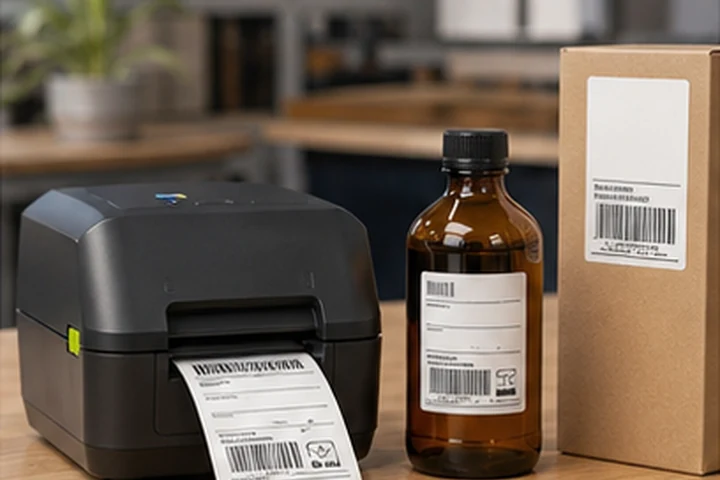
Choose thermal transfer for monochrome product labels that need durable barcodes, lot codes and text. Choose color inkjet when each finished label needs full-color branding or photographs. Use direct thermal mainly for short-life products and temporary price or rotation labels.
Decision table
| Product requirement | Starting technology |
|---|---|
| Black barcode, serial number and durable text | Thermal transfer |
| Full-color brand graphics in short runs | Color inkjet |
| Preprinted brand label plus variable code | Thermal transfer overprint |
| Temporary food rotation or price label | Direct thermal |
| Harsh chemicals or abrasion | Resin transfer on qualified synthetic |
Separate fixed and variable content
Brand graphics and regulatory text that rarely change can be preprinted by a label converter. An on-demand printer then adds variable barcodes, dates, batches and serial numbers. This hybrid model often gives better color consistency and lower variable-print complexity.
Material and adhesive
Product packaging may be glass, corrugated board, PET, HDPE, LDPE or coated metal. Each surface has different energy, texture and curvature. Add refrigeration, condensation, oil or repeated squeezing, and adhesive selection becomes as important as printer selection.
Resolution and barcode verification
300 dpi is a useful general choice for compact product labels containing small text and 2D symbols. However, resolution does not permit arbitrary shrinking. Follow the applicable barcode standard and verify production samples. GS1 emphasizes symbol size, contrast, quiet zones and correct construction.
Compliance boundary
The printer only reproduces the supplied design. It does not make the label legally compliant. Ingredient, hazard, food-contact, healthcare and market-specific requirements should be reviewed by a qualified specialist for the target jurisdiction.
Frequently asked questions
Can a thermal printer print a company logo?
Yes, in monochrome. Fine details depend on the native resolution and the graphic preparation.
Should I print product labels in-house?
In-house printing is useful for frequent changes, short runs and variable data. High-volume fixed artwork may be more economical and consistent when professionally preprinted.
Is 600 dpi required for small product labels?
Only in specialist cases. Start by testing 300 dpi and ensure barcode dimensions remain compliant.