Quick answer
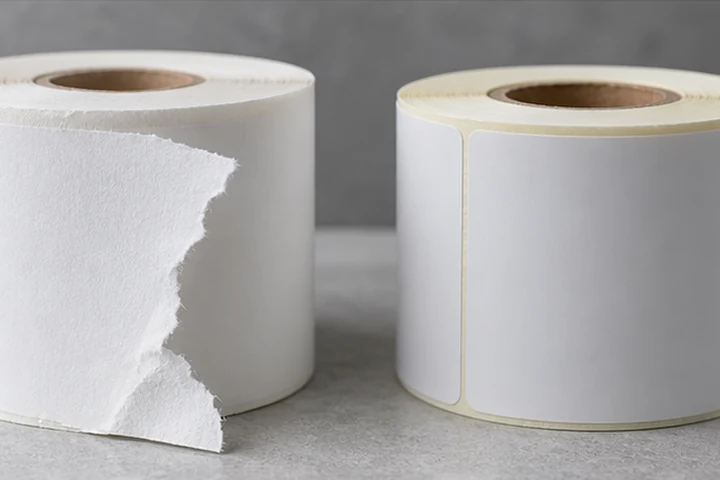
Choose paper labels for economical, dry and relatively short-life applications. Choose synthetic labels when the label must resist tearing, water, abrasion, chemicals or long service. The correct adhesive and print method remain essential whichever facestock you select.
Comparison
| Factor | Paper | Synthetic film |
|---|---|---|
| Initial cost | Usually lower | Usually higher |
| Tear resistance | Low | Medium to very high |
| Moisture resistance | Limited unless protected | Generally better |
| Conformability | Good on many flat surfaces | Depends on film type and thickness |
| Print options | Direct thermal or thermal transfer | Direct thermal film or transfer with matched ribbon |
| Typical life | Short to medium | Medium to long |
When paper is enough
Paper is a practical choice for shipping cartons, indoor inventory, retail price labels and work-in-process labels that remain dry. It offers good print contrast and broad adhesive availability. Coatings can improve smoothness and limited resistance, but the structure still contains paper fibers.
Do not pay for synthetic durability when the package and label will be discarded within days under controlled conditions.
When synthetic is justified
Polypropylene, polyester and vinyl are common synthetic families. They are selected for bottled goods, assets, electronics, outdoor equipment, chemical containers and reusable totes. Each behaves differently: polypropylene is often flexible, polyester is dimensionally stable, and vinyl can conform to curved surfaces.
Synthetic does not mean indestructible. UV exposure, plasticizers, solvents, heat and surface movement can still cause failure.
Adhesive is a separate decision
Facestock protects the printed surface; adhesive keeps it attached. Evaluate the substrate material, roughness, curvature, contamination, application temperature and required removability. A durable polyester face with the wrong adhesive can fall off sooner than a simple paper label with a suitable adhesive.
Print compatibility
For thermal transfer, wax commonly suits paper, wax-resin covers coated paper and selected matte synthetics, and resin is used for demanding synthetic applications. These are starting points only. Ribbon suppliers qualify specific combinations.
Frequently asked questions
Are synthetic labels recyclable?
Recyclability depends on the complete package, film, adhesive, liner and local collection system. Ask the material supplier for construction-specific guidance.
Can paper labels resist refrigeration?
Some coated papers and adhesives are designed for chilled conditions, but condensation and wet handling require testing.
Is direct thermal available on synthetic material?
Yes. Direct thermal films exist, but their image is still created by a heat-sensitive coating and has different exposure limits from a transfer-printed resin image.