Quick answer
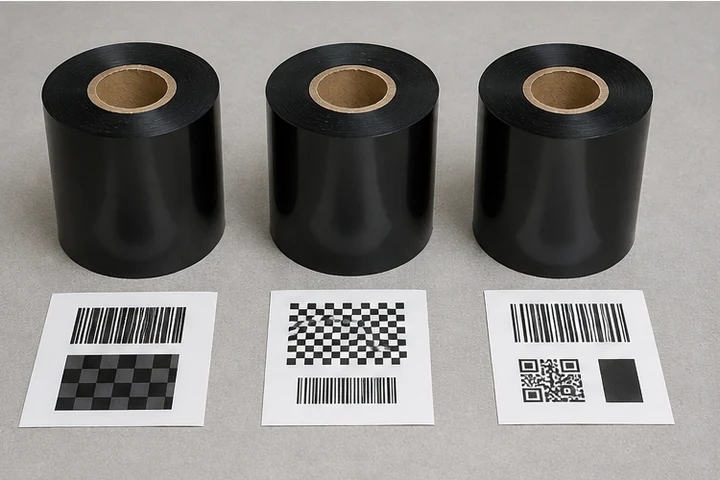
Use wax ribbon for economical printing on paper with little abrasion or chemical exposure. Use wax-resin for coated paper and many matte synthetic labels that need better smear and chemical resistance. Use resin for compatible synthetic labels exposed to heavy abrasion, chemicals, heat or long service. Always test the exact ribbon and facestock together.
Ribbon comparison
| Ribbon | Typical media | Relative durability | Common applications |
|---|---|---|---|
| Wax | Uncoated and coated paper | Basic | Shipping, inventory, retail tags |
| Wax-resin | Coated paper and selected matte synthetics | Medium to high | Product, warehouse and general durable labels |
| Resin | Compatible matte or gloss synthetics | Highest | Chemical drums, electronics, outdoor and asset labels |
Wax ribbon
Wax formulations release at relatively low print energy and can run quickly. They are usually the lowest-cost option and produce strong barcode contrast on suitable paper. Their weakness is resistance: rubbing, moisture, oil or solvents may damage the printed image.
Choose wax when the label stays dry, receives limited handling and does not need multi-year legibility. Increasing darkness is not a substitute for choosing a more durable formulation.
Wax-resin ribbon
Wax-resin blends provide a useful middle ground. They generally resist smearing and scratching better than wax and can tolerate moderate chemical exposure. They work on many coated papers and selected synthetics, but compatibility varies by formulation.
This is often the best starting point for product identification and warehouse labels when plain wax is not durable enough but full resin is unnecessary.
Resin ribbon
Resin formulations are designed to bond to compatible synthetic surfaces. They normally require more energy and may run at lower speeds. When correctly matched, they provide the strongest resistance to abrasion, chemicals and high temperatures.
Resin is not automatically best. It can fail to anchor on an unsuitable surface and increases supply cost. Select it because testing shows that the application needs it.
Compatibility checks
Confirm these before ordering production quantities:
- Printer model, width and winding direction
- Ribbon width at least as wide as the media path recommended by the manufacturer
- Ink side in or ink side out
- Label facestock and topcoat
- Required resistance to rubbing, water, oil, alcohol and cleaning agents
- Print speed and darkness range
- Barcode verification after environmental testing
Frequently asked questions
Can resin ribbon print on paper?
Some combinations may produce an image, but resin is intended primarily for compatible synthetics and may not bond well to ordinary paper. Follow the ribbon supplier's compatibility matrix.
Does darker printing mean better durability?
No. Excessive heat can spread barcode bars, wrinkle ribbon and damage the printhead. Durability comes from material compatibility and controlled settings.
Can ribbon brands be mixed with printer brands?
Often, but dimensions, winding, coating, backcoat and formulation must be compatible. Validate print quality and warranty implications.