Quick answer
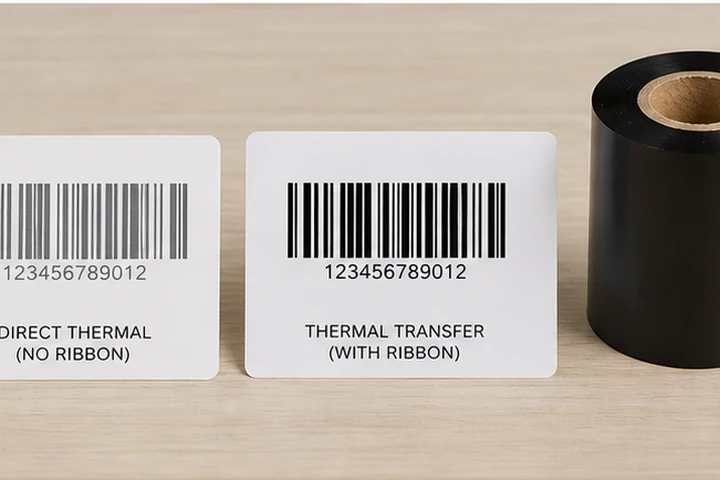
Choose direct thermal for short-life labels when simplicity and fewer consumables matter most. Choose thermal transfer when the printed image must survive abrasion, sunlight, moisture, chemicals or long storage. The application, not the printer price alone, should decide the method.
Side-by-side comparison
| Decision factor | Direct thermal | Thermal transfer |
|---|---|---|
| Ribbon | Not required | Required |
| Label media | Heat-sensitive direct thermal stock | Paper or synthetic transfer stock |
| Typical image life | Shorter and environment-dependent | Longer with a matched ribbon and label |
| Heat and UV sensitivity | Higher | Lower with suitable supplies |
| Abrasion resistance | Limited | Moderate to high |
| Chemical resistance | Limited | Can be high with resin and synthetic media |
| Loading | Faster and simpler | Label and ribbon must both be loaded |
| Best fit | Shipping, receipts, temporary tracking | Product, asset, laboratory and outdoor labels |
When direct thermal is the better choice
Direct thermal works well when a label only needs to remain readable through a known short process. Common examples include parcel labels, food rotation labels, event badges, parking receipts and pick tickets. With no ribbon to buy or load, it reduces the number of supplies an operator manages.
Do not assume every direct thermal label has the same life. Coatings, topcoats, adhesive, storage temperature, light and handling all affect performance. Test the actual construction under the intended conditions.
When thermal transfer is the better choice
Thermal transfer is normally the safer choice for serial numbers, product identification, asset tracking, outdoor storage and labels exposed to cleaning agents. It can print on coated paper, polypropylene, polyester and other engineered facestocks.
Durability comes from the complete system. A resin ribbon on an incompatible surface can print poorly, while an appropriately matched wax-resin ribbon may outperform it in a particular application. Always test the exact printer, ribbon, label and darkness setting together.
Cost comparison
Direct thermal avoids ribbon cost, but the labels themselves may cost more than basic thermal transfer paper. Thermal transfer adds ribbon inventory and operator time, yet it can reduce relabeling when labels must last. Compare cost per usable label, not simply cost per roll.
Include these items in a total-cost calculation:
- Printer and optional cutter, peeler or rewinder
- Labels, ribbon and shipping waste
- Loading and calibration time
- Failed scans, reprints and relabeling
- Printhead and platen roller replacement
- Downtime caused by unsuitable supplies
A simple decision rule
Start with the expected label life and exposure. If the label is discarded within months and stays indoors, test direct thermal. If it must remain readable for years or face heat, sun, friction, moisture or chemicals, test thermal transfer. Then verify barcode quality at the fastest practical speed and lowest workable darkness.
Frequently asked questions
Is thermal transfer always waterproof?
No. Water resistance depends on the label facestock, adhesive, ribbon and printing conditions. A paper label can absorb water even when the printed image remains legible.
Is direct thermal suitable for shipping labels?
Usually, yes. Shipping labels normally have a short service life and are protected during transit. Exposure to high heat, direct sunlight or heavy abrasion still requires testing.
Can thermal transfer print without a ribbon?
Only if the printer supports direct thermal mode and direct thermal media is installed. A thermal transfer label will not create an image without ribbon.