Quick answer
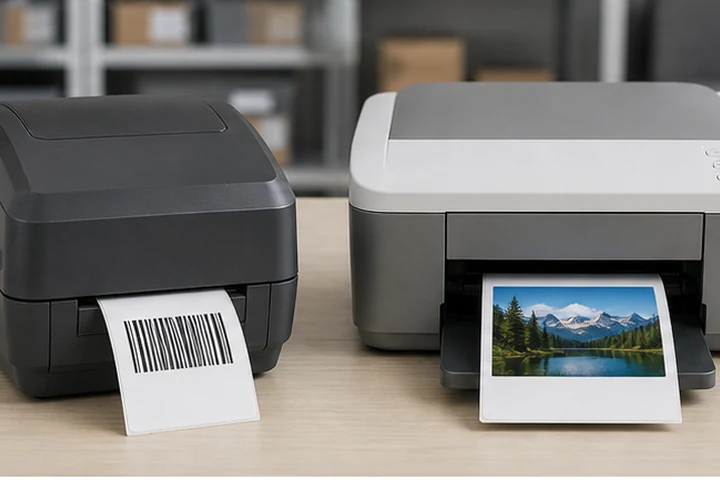
Use a thermal label printer for reliable on-demand barcodes, shipping labels and variable operational data. Use an inkjet label printer when color is essential for branding, photographs, hazard communication or product presentation. Neither technology is universally cheaper; the right answer depends on coverage, volume and label life.
Comparison at a glance
| Requirement | Thermal | Inkjet |
|---|---|---|
| Black barcodes and text | Excellent fit | Capable with correct media and maintenance |
| Full color | Usually not available | Primary advantage |
| Consumables | Direct thermal labels or labels plus ribbon | Ink plus inkjet-coated labels |
| Start-stop operation | Well suited | Nozzles may require cleaning after idle periods |
| Image durability | Depends on thermal method and supplies | Depends on ink chemistry, coating and lamination |
| Typical workflow | Shipping, inventory, assets, receipts | Product labels, color coding, short-run packaging |
Where thermal printing wins
Thermal printers are designed around adhesive label media and sharp variable data. There is no wet ink to dry. Direct thermal models have few consumables, while thermal transfer models can create highly durable images with a matched ribbon and synthetic label.
They are especially effective when every label contains a different order number, serial number, date or barcode and must print immediately at a workstation.
Where inkjet wins
Inkjet is the practical choice when the label itself carries brand color, photographs or many colors of instructional information. It can allow a business to keep blank stock and print multiple product variations on demand instead of ordering preprinted rolls.
The label must be coated for the selected ink technology. Pigment and dye inks behave differently, and water, UV and abrasion resistance depend on the complete construction. Lamination or varnish may be required for demanding service.
Cost questions to ask
- How much of each label is covered with ink or ribbon?
- Is full color required, or can color be preprinted with thermal variable data added later?
- How often will cartridges, printheads, labels and ribbons be replaced?
- Does the printer need automatic cutting or rewinding?
- What is the cost of cleaning, wasted labels and production downtime?
A hybrid workflow is common: a converter preprints brand colors, and a thermal printer adds barcodes, dates and lot numbers at the point of use.
Barcode quality
Both technologies can print scannable barcodes when correctly configured. The final symbol must have adequate size, contrast, quiet zones and print quality. Do not choose a printer by nominal dpi alone; verify samples produced on the exact media at operating speed.
Frequently asked questions
Can an inkjet printer print shipping labels?
Yes, but a dedicated thermal printer is usually simpler for repeated 4 x 6 inch carrier labels because it is optimized for roll media and variable barcode output.
Are thermal labels always black only?
Most on-demand thermal output is monochrome. Colored label stock, preprinted graphics and some specialty ribbons are available, but they do not replace process-color inkjet printing.
Which technology needs less maintenance?
Direct thermal has the fewest consumables, but all printers require cleaning. Inkjet maintenance focuses on nozzles and ink systems; thermal maintenance focuses on the printhead, platen, sensors and media path.